
Austintown Township City Directory Collections
Austintown Township is not an incorporated city, so the historical starting point is the Youngstown and Mahoning Valley directory shelf rather than a proven standalone annual Austintown series. The Mahoning Valley Historical Society directory listing identifies Youngstown volumes for 1869, 1872, 1875/76, and 1877 to the present. Its important caution is that most volumes concern the City of Youngstown. Some editions reach nearby communities, but township coverage must be checked in the physical or digitized volume before a missing name is treated as meaningful.
| Collection | Years | Where held | Access |
|---|---|---|---|
| Youngstown city directories | 1869; 1872; 1875/76; 1877 to present | MVHS Research Center | Check each volume for Austintown Township scope. |
| Polk Youngstown directory | 1886-87 | Historic scan with MVHS collection context | Contents include Austintown and West Austintown sections. |
| PLYMC genealogy databases and Digital Archive | Collection dependent | Public Library of Youngstown & Mahoning County | Some tools require library access, a card, or a free account. |
| Vindicator in MyHeritage Library Edition | 1869-2009 stated coverage | PLYMC genealogy resources | Search result quality is limited by missing and poor scans. |
The 1886-87 Polk book is especially useful because its contents expressly name both Austintown and West Austintown. That is evidence for one edition, not proof of an uninterrupted township run. MVHS also lists Warren material and a Trumbull County farm and business directory, but those are regional companions rather than substitutes for a verified Austintown Township residence listing.
Austintown Township Directory Scope by Volume
Start by locating the table of contents, locality headings, and abbreviation pages. An Austintown Township name might appear in an Austintown section, a West Austintown section, a rural locality, an alphabetical list, or business material. The 1886-87 Polk contents show that a directory can divide nearby places into separate sections. That detail changes the search method: check the edition's scope first, then search the surname and address variants that match its own arrangement.
Directories do not all answer the same question. A name can mark a residence, a boarding arrangement, a business connection, or a place of work. A person missing from an edition may have been outside its geography, omitted by the compiler, recorded under a variant, or not included in that category. It is safer to preserve the exact printed wording and the volume and page than to turn a single line into a broad claim.
Note: A Youngstown title alone does not establish that an edition indexed Austintown Township residents.
Austintown Township Directory Access at MVHS
The Mahoning Valley Historical Society government-records collection adds local paper sources that can test a directory clue. Its holdings include Mahoning poll books from about 1850 to 1871, probate estate packets from 1846 to 1900, Common Pleas files from about 1846 to 1876, recorded deed, mortgage, and lease ledgers from about 1856 to 1863, and an Austintown Township tax assessment ledger for 1859. Those records are historic leads, not an online people index or proof of a present address.
A PLYMC Mahoning County genealogy guide is a useful companion when planning the local library, Microfilm Department, and county-office path. The MVHS research center asks patrons to make an appointment at 330-743-2589. Call with the surname, year range, place labels, and record type. That makes it possible to ask whether a particular directory or paper record is held without assuming staff will conduct an open-ended search.
PLYMC's Mahoning County genealogy guidance shows the local research path behind historical directory work.
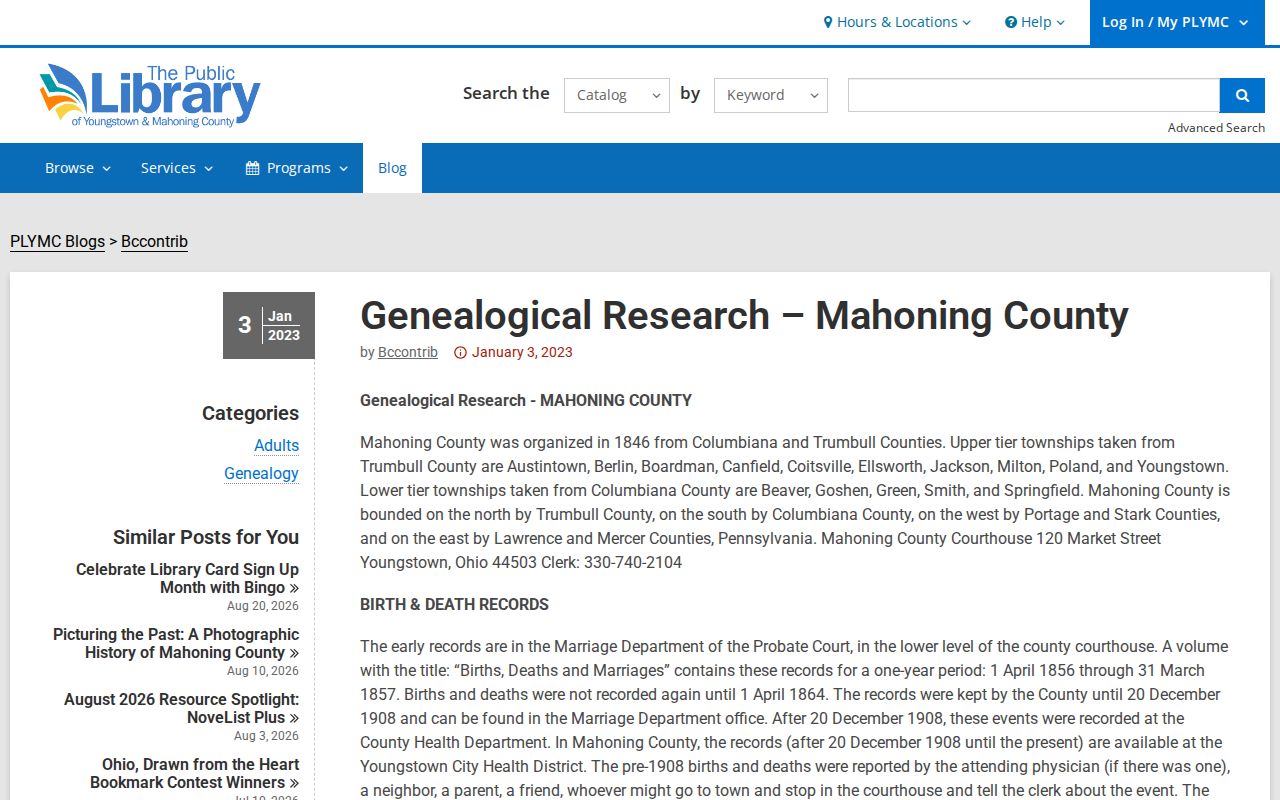
The library route matters when a directory line needs a census, newspaper, microfilm, or vital-record cross-check instead of a guess about the household.
Reading Austintown Township City Directory Entries
The inspected 1886-87 Polk directory shows a compact city directory entry style. It can give a surname, given name or initial, occupation or relationship, a work abbreviation, an employer or enterprise when supplied, and a residence notation tied to a numbered street or locality. The entry itself is historical evidence of what the compiler printed. It is not a present address, a title record, or a full household list.
| Name and initials | Identify a candidate in one publication year, then compare relatives and address clues across records. |
|---|---|
wks. | Signals a work relationship or occupation when the volume uses it; read it with the volume's own key. |
res. | Marks the residence or locality printed by the compiler, useful as a dated lead. |
wid. | A widow notation that may point to a death, probate, or newspaper search. |
bds. | A boarding or lodging notation, not proof of ownership or every person in the household. |
- Criss-cross directory
- A directory arranged by address or street rather than by surname. No verified Austintown Township criss-cross run should be assumed.
- Householder index
- An index that groups a household under a lead name. It can be helpful, but it is not the same as a census enumeration.
- Abbreviation key
- The printed guide to marks such as
res.,wks., andwid.; copy it before expanding an entry into plain language.
Note: Keep a transcription beside a photo or citation to the original volume and page.
Austintown Township Newspaper Limits
PLYMC genealogy resources provide a bridge from city directories to newspapers, online databases, a Digital Archive, Sanborn material, and school-yearbook paths. The library describes Youngstown Vindicator coverage in MyHeritage as 1869 through 2009, while also warning that some issues are missing or poorly digitized. A failed keyword search can therefore mean an imperfect scan, an omitted issue, or a different spelling, not necessarily that no notice was printed.
The same caution applies to maps. MVHS lists documented Youngstown Sanborn ranges, but the published list does not prove a Sanborn edition for Austintown Township. Use the library's wider Sanborn resource to check a particular place, and do not supply a local map year until the database or collection confirms it.
MVHS government-record holdings document the paper sources that can support a directory clue.
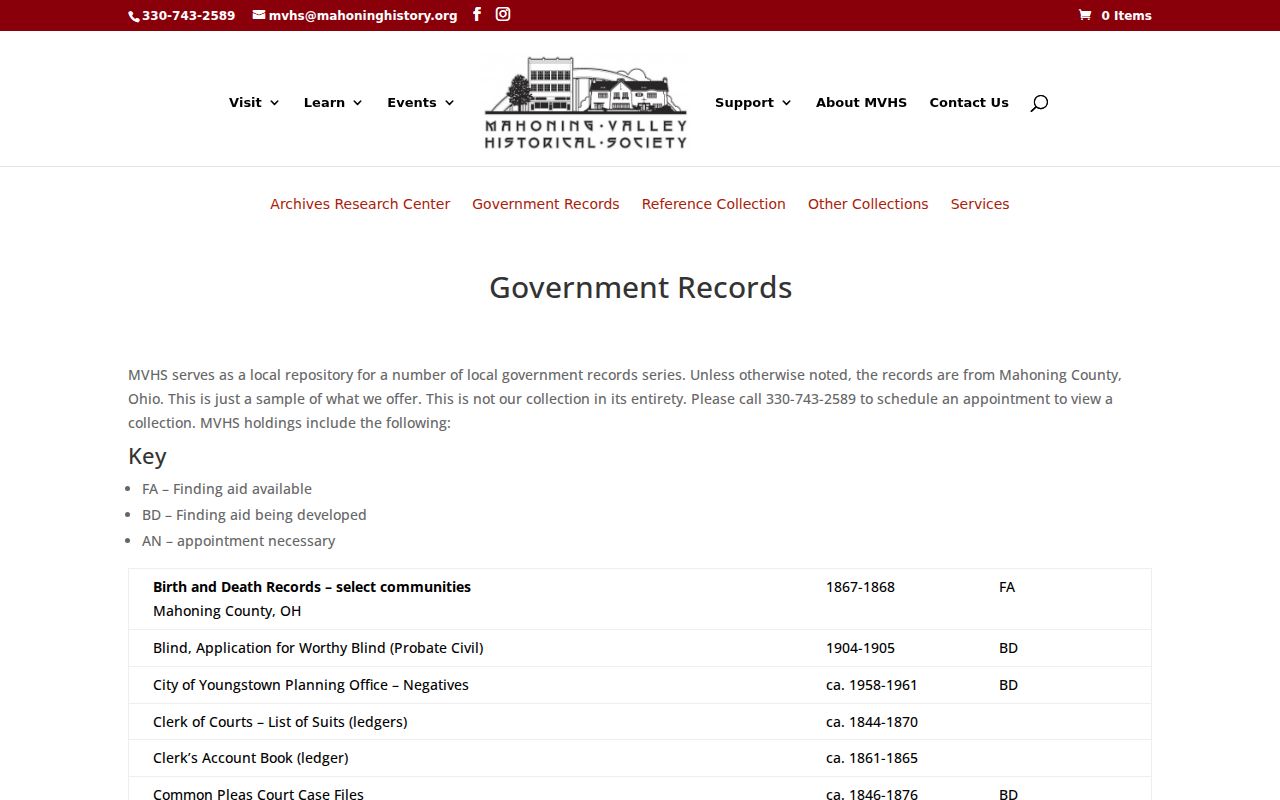
The 1859 Austintown Township tax assessment ledger is a separate historical record layer, useful for a dated land or name lead but not a replacement for a directory entry.
Austintown Township Community Record Context
Some local collections add context that no city directory can provide. MVHS lists the Austintown Township chapter records of the Women's Christian Temperance Union for 1939 through 1967, alongside church, cemetery, map, census, industrial, fraternal, and social-organization materials. These are historical collections, not current membership rosters. A family name, church, cemetery, or organization can give the research center a practical finding aid term after a directory search identifies the right era.
For a death-to-address trail, the township cemetery inventory, MVHS's Austintown Township Cemetery and Death Records compilation, PLYMC newspapers, and probate packets can be used in sequence. Verify a transcription against the cited source when possible. A cemetery record can support a date or family connection, while probate and recorded land documents answer different parts of the historical question.
Tracing Austintown Township City Directories
A careful household trace starts with the closest verified directory edition, not with an assumed yearly series. Capture the name form, locality, residence line, abbreviation key, volume, and page. Then move one available volume in either direction. The released federal census provides a household snapshot, while a city directory can add a nearer-in-time address or occupation clue. As of the research date, 1950 is the newest released federal population census.
- Check whether the selected directory has an Austintown or West Austintown section before treating an absence as a result.
- Copy the entry exactly, including initials, locality, abbreviations, year, and page.
- Inspect the nearest available volume before or after it for a move, spelling change, widow notation, or altered listing.
- Pair the directory date with the nearest released census, keeping the directory resident line distinct from the census household.
- Use cemetery, obituary, probate, or deed evidence only when the names, locality, and dates align.
A disappearance can reflect a move, death, a changed locality label, or a volume that did not cover the township. It does not prove one explanation by itself. For current address-keyed parcel work, the separate Austintown Township street directory route uses the Auditor and Recorder rather than the historical shelf.
Note: A directory and a census complement each other because each records a different date and purpose.
Austintown Township Records Before Mahoning
Older directory research has a jurisdiction warning. Mahoning County was organized in 1846 from Columbiana and Trumbull counties, and PLYMC identifies Austintown among the upper-tier townships taken from Trumbull. A pre-1846 family, land, or census search may belong under Trumbull County rather than Mahoning County. Keep the historic place label in notes instead of forcing every early record into a later county name.
This boundary change is one reason a city directory search benefits from a year, a road or locality, and a source citation. The township, West Austintown, Youngstown, Mahoning County, and Trumbull County labels can each be correct for different records and periods.
Austintown Township Directory Death Sources
When a directory trail ends near a death or estate event, move from the printed line to a dated source. MVHS lists Austintown cemetery and death material, and the Youngstown Vital Statistics Division is the local issuing route for Mahoning birth and death records with stated exceptions. County reporting before December 20, 1908 was irregular, so an early nonmatch is not a final conclusion. PLYMC also notes that WPA index cards could omit unreadable entries.
Use an obituary or cemetery finding to form a narrow probate or vital-record question. Ohio's vital-record copy rule requires a signed application and fee for a certified copy unless a statute makes the record nonpublic, while protecting the medical and health portion of a birth record. Keep the directory date separate from the later record date.